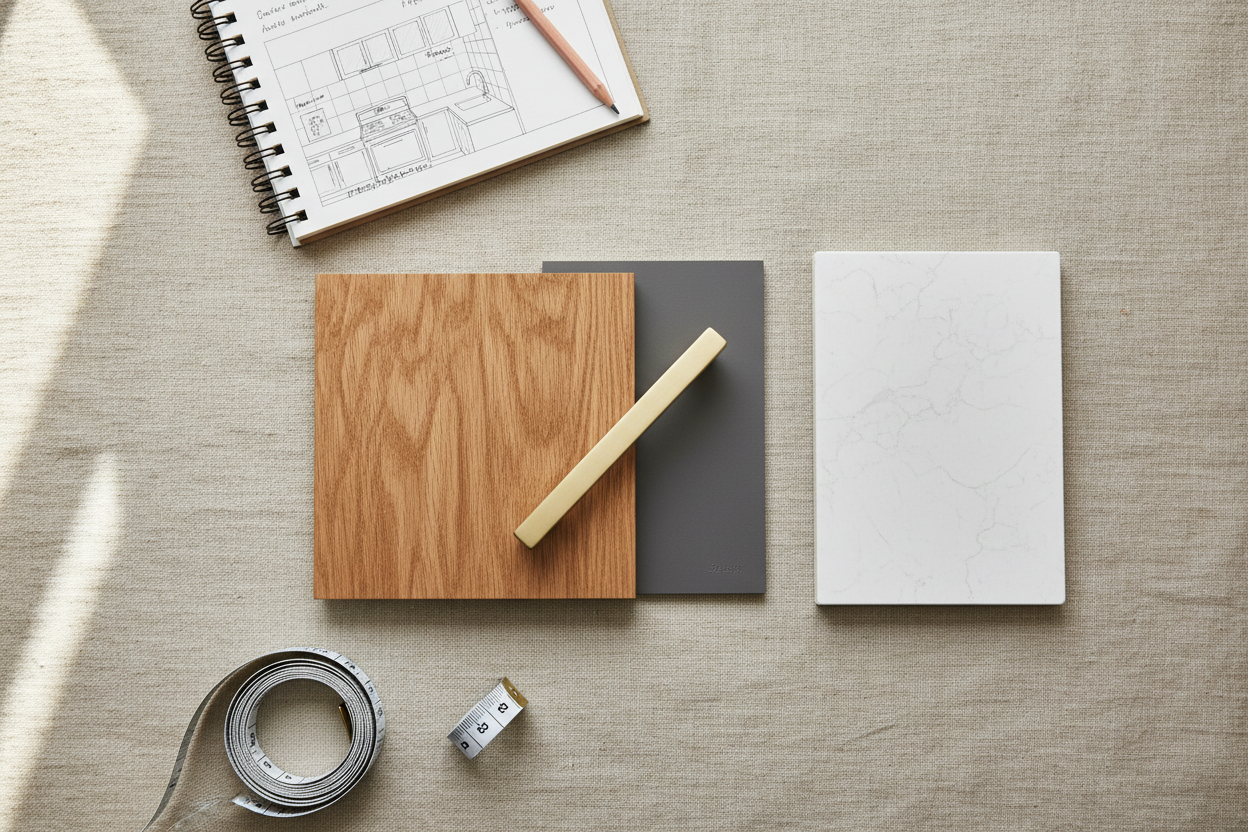
Why Order a Cabinet Door Sample First (and What to Check When It Shows Up)
Buying a whole kitchen's worth of cabinets without holding one in your hands first is a strange kind of leap of faith. You're judging color from a screen that's lying to you a little, judging quality from product photos, and trusting that "soft-close" and "all-plywood" mean what you hope they mean.
A door sample fixes that for the price of a couple of coffees. Here's why it's worth doing, and more usefully, what to actually look at once it shows up so the $30 tells you something.
Why a screen can't be trusted for this
Two reasons, both about getting it wrong in ways that are expensive to undo.
First is color. Every monitor and phone renders it differently, and none of them show you how a finish reads in your kitchen, under your lighting, against your floor and counters. A white that looks crisp on screen can come off warm or gray on the wall. A navy that's perfect at noon can go near-black after dark. You only learn that by putting the real thing in the real room.
Second is build quality, which photos flatter by default. A sample lets you feel the weight of a solid plywood door, run a thumb over the finish, and work the hinge yourself. None of that comes through in a listing.
What to check when the sample arrives
This is the part people skip. Don't. Give it ten real minutes:
- Color, in your actual light. Set it on the counter and look in the morning. Look again at night under your kitchen lights. Hold it next to your flooring and any counter sample you have. The goal is no surprises later.
- The finish, up close. You want an even, consistent coat with no thin spots or rough patches. Run a finger across it. It should feel smooth and solid, not tacky or hollow.
- The weight. A real plywood door has heft. A sample that feels suspiciously light is often particleboard or MDF hiding under a finish. Ours isn't, and now you can confirm it instead of taking our word for it.
- The soft-close. If the sample includes the hinge, open it and let go. It should ease shut on its own, slow and silent, every time. Try to make it slam. A good hinge won't let you.
- The edges and joinery. Corners should be clean and tight. That's the difference between a cabinet that stays square for decades and one that works loose.
Pass all that and you're not guessing anymore. You're buying something you've already inspected.
How the $30 works
The sample is $30, and it's credited back to your order when you buy. Go ahead with the kitchen and the sample effectively cost you nothing. You're really just putting a small, refundable deposit on certainty.
That's deliberate. A free-for-all sample program tends to pull in people who aren't actually remodeling, and we'd rather get real samples into the hands of people who are. The $30 keeps it serious and comes straight back to you at checkout.
Quick questions
Can I order more than one finish? Yes, and it's a smart move if you're torn between two colors or weighing a two-tone scheme. Seeing them side by side in your own kitchen usually settles it fast.
How long does a sample take to arrive? Samples ship quickly, well ahead of a full cabinet order. It's the low-commitment first step while you're still planning.
Do I have to buy after ordering a sample? No obligation at all. The credit is there if you move forward, and if a finish isn't right, you've saved yourself from learning that across an entire kitchen.
Start with the finish
The whole point is to take the gamble out of an online cabinet purchase. Order a $30 door sample, give it the ten-minute once-over above, and decide from a place of actually knowing. When you're ready for the layout, the free 3D design service is the natural next step.