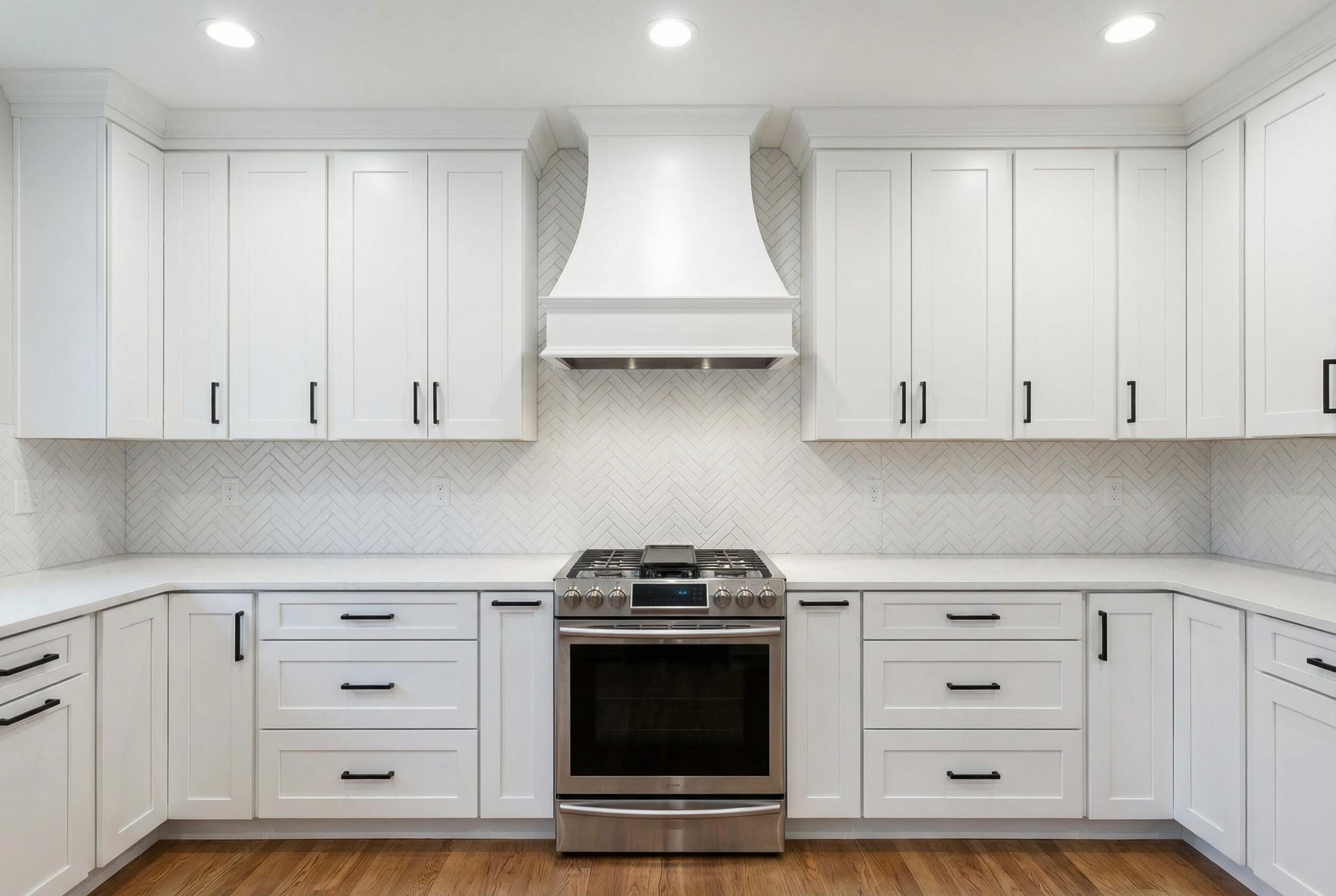
Soft-Close Cabinets: The Small Thing You'll Be Glad You Didn't Skip
There's a sound every kitchen makes when nobody's being careful: the flat bang of a cabinet door catching the frame, usually around 6 a.m. while someone's still half-asleep and reaching for a mug. Soft-close hardware is what makes that sound disappear.
If you've never lived with it, it's hard to explain why such a small detail matters this much. If you have lived with it, you already know. Going back to doors that slam feels like a step down.
So here's the straight version: what soft-close actually is, why it's worth caring about, and what to check before you assume a cabinet has it.
What "soft-close" really means
It isn't motorized, and there's nothing to charge. A soft-close hinge has a small fluid-filled damper built into it, basically a tiny shock absorber. Push the door toward shut and the damper catches it in the last inch or two, then eases it the rest of the way, slow and silent. Drawers do the same trick with a damper on the slide.
That's the whole thing. No batteries, no app, nothing that beeps at you. Just a door that won't slam no matter how distracted you are.
It's quieter, but that's not the real reason it matters
The quiet is the part you notice first. The part that saves you money is what slamming does over time.
Every hard close sends a jolt through the cabinet: the joints holding the box together, the screws in the hinge, the finish along the edge where the door meets the frame. Do that a few thousand times a year, which a busy kitchen easily does, and things loosen, chip, and wear. Soft-close takes that abuse out of the picture, so the cabinets stay tight and keep looking new for longer.
A few other things you'll appreciate without thinking about them: no pinched fingers when a kid swings a door shut, no dishes rattling when you close an upper, and that small, hard-to-name "this is a nice kitchen" feeling every time you use it.
So, are soft-close cabinets worth it?
Yes, with one caveat worth knowing.
A decade ago, soft-close was a premium upcharge. Now it's close to standard on any cabinet worth buying. The catch is that "soft-close" on a spec sheet doesn't always mean the same thing. Some sellers put it on the doors but leave the drawers on basic slides. Some charge for it as an upgrade tier. And some use bargain dampers that feel jerky out of the box and quit working inside a year or two.
So the feature being listed isn't the whole story.
What to actually check
- Doors and drawers, or just doors? Drawers get yanked harder than doors do, so soft-close matters there at least as much.
- Standard or an add-on? If it's a paid upgrade, fold that into the real price before you compare.
- Does it feel smooth? A good hinge eases shut in one continuous motion. A cheap one catches, stutters, or barely slows the door at all.
If you can get your hands on a sample, open and close it a few times. The difference between good hardware and the cheap stuff shows up in about three seconds.
How we handle it at Quik
Soft-close is standard on every door and every drawer we make. No upcharge, no "premium hardware" line item. Same goes for the dovetailed drawer boxes. It's the kind of thing that should just come with a real cabinet, so it does.
The easiest way to judge it is to feel it yourself, which is why we'll ship you a $25 door sample. Open it, close it, try to make it slam. (You can't.)
A few quick questions people ask
Do soft-close hinges wear out? Good ones are built to last the life of the cabinet. Cheap dampers are the ones that fail, which is exactly why hardware quality is worth checking before you buy.
Can I add soft-close to cabinets I already have? Often, yes. There are replacement hinges and little adapters for drawers. It's fiddly and not always worth the effort, though. If you're buying new anyway, built-in is the simpler path.
Are "soft-close" and "self-close" the same thing? No. Self-close uses a spring to pull the door the last bit, and it can still tap shut with a little noise. Soft-close eases it in slowly and quietly. If silence is the goal, soft-close is the one you want.
Feel it before you commit
The whole point of soft-close is that it's something you experience, not something you read about. Order a $25 door sample and try it in your own kitchen, or browse the full range if you're ready to start planning.