Plywood vs Particleboard vs MDF Cabinets: Why the Box Material Decides Everything
Plywood is the strongest and most moisture-resistant cabinet box material; particleboard is the cheapest and weakest; MDF sits in between and is best suited to painted door applications rather than cabinet boxes. The box material determines how a cabinet handles a leak, how much a shelf can hold without sagging, and whether hinge screws still bite in year ten. Here's the full comparison — and how to tell what a cabinet is actually made of before you buy.
What's the difference between the three materials?
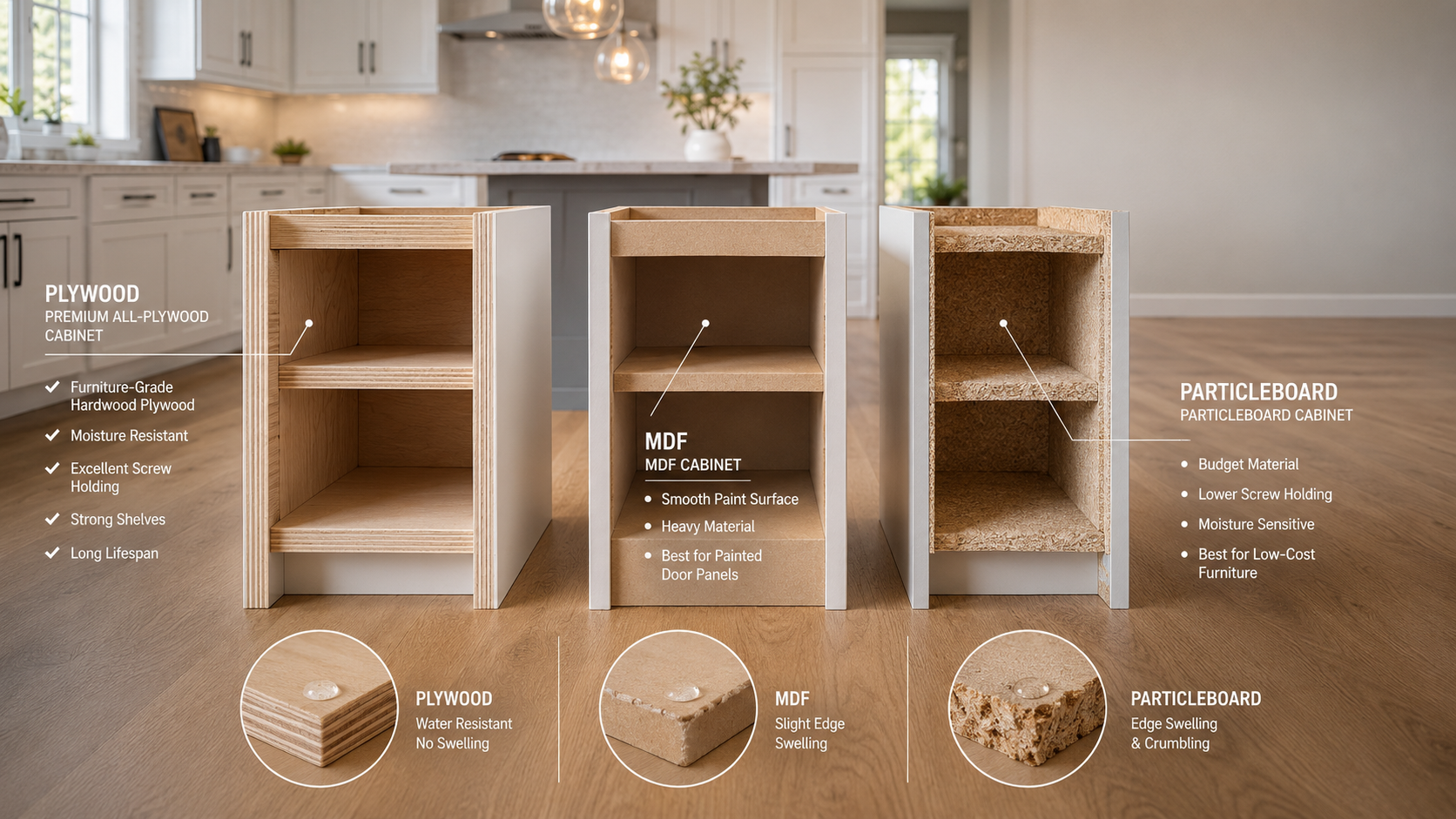
- Plywood — thin layers of real wood veneer glued with alternating grain direction. The cross-grain structure is what gives it strength and screw-holding power.
- Particleboard — wood chips and sawdust pressed with resin. Cheap and flat, but weak at edges and helpless against water.
- MDF (medium-density fiberboard) — fine wood fibers pressed denser than particleboard. Smooth and stable, which makes it popular for painted door panels, but heavy and still moisture-vulnerable as a box material.
Head-to-head comparison
| Property | Plywood | MDF | Particleboard |
|---|---|---|---|
| Moisture resistance | Best — dries out, keeps shape | Poor — swells, doesn't recover | Worst — swells and crumbles |
| Screw holding | Excellent — cross-grain grips threads | Fair — strips under repeated load | Poor — strips easily |
| Shelf strength (sag) | Best per pound | Good but very heavy | Sags under load over time |
| Weight | Lightest of the three | Heaviest | Heavy |
| Repairability | Sands, re-screws, patches | Limited | Very limited |
| Cost | Highest | Middle | Lowest |
| Best use | Cabinet boxes, shelves, drawers | Painted door center panels | Budget furniture |
Why does moisture resistance matter so much in kitchens?
Kitchens are wet rooms. A slow supply-line drip under the sink, a dishwasher steam leak, a mopped floor splashing toe kicks — every kitchen cabinet meets water eventually. Plywood absorbs the incident and dries; particleboard swells like a sponge and never returns to shape. This is why sink base cabinets are the first casualty in particleboard kitchens and why insurance-claim kitchen rebuilds so often start under the sink.
Why do big brands still use particleboard?
Cost, weight, and machine-friendliness at massive scale. Flat-pack giants and big-box house lines are built to hit a shelf price. That's a legitimate trade-off for a rental or a five-year flip — it's a poor one for a kitchen you plan to keep. It's also why comparing an all-plywood RTA cabinet against a big-box particleboard cabinet at a similar price is not the even matchup it looks like — see our IKEA comparison and Home Depot comparison for the line-by-line breakdown.
How can you tell what a cabinet is really made of?
- Read the spec sheet, not the headline. "Plywood construction" sometimes means plywood sides with a particleboard back, shelves, or drawer bottoms. Look for "all-plywood box."
- Check the edges. Plywood shows layered veneer stripes on a raw edge; particleboard shows uniform speckled chips; MDF is smooth and fiber-uniform like heavy cardboard.
- Lift a shelf. A plywood shelf is noticeably lighter than an MDF or particleboard one of the same size.
- Check the drawers. Makers that use plywood boxes usually pair them with solid wood dovetail drawers; stapled particleboard drawers are a tell for the whole cabinet. (Dovetail vs stapled, explained.)
Where Quik Cabinets stands
Every Quik cabinet is built with an all-plywood box and face frame and a solid wood door frame, with dovetail drawer boxes and soft-close hardware standard across all three series. The honest way to check any of this is in your hands, not on a screen — order a $30 door sample (the price is credited to your order) and inspect the edges yourself.
FAQ
Is MDF ever acceptable in a good cabinet?
Yes — as a painted door center panel, where its smooth, grain-free surface takes paint cleanly and resists cracking at the panel. As a cabinet box material, plywood is the better choice.
Are plywood cabinets worth the extra cost?
For a kitchen you'll keep more than a few years, yes. The failure points of cheaper materials — swollen sink bases, stripped hinge screws, sagging shelves — are exactly the repairs that cost more than the original material savings.
What plywood grade should cabinet boxes use?
Furniture-grade hardwood plywood (such as birch) with a smooth interior veneer. Construction-grade plywood is structural, not furniture material.
Does particleboard always fail?
Not always — kept bone-dry and lightly loaded, it serves fine. Kitchens are simply the wrong room to bet on "kept bone-dry."