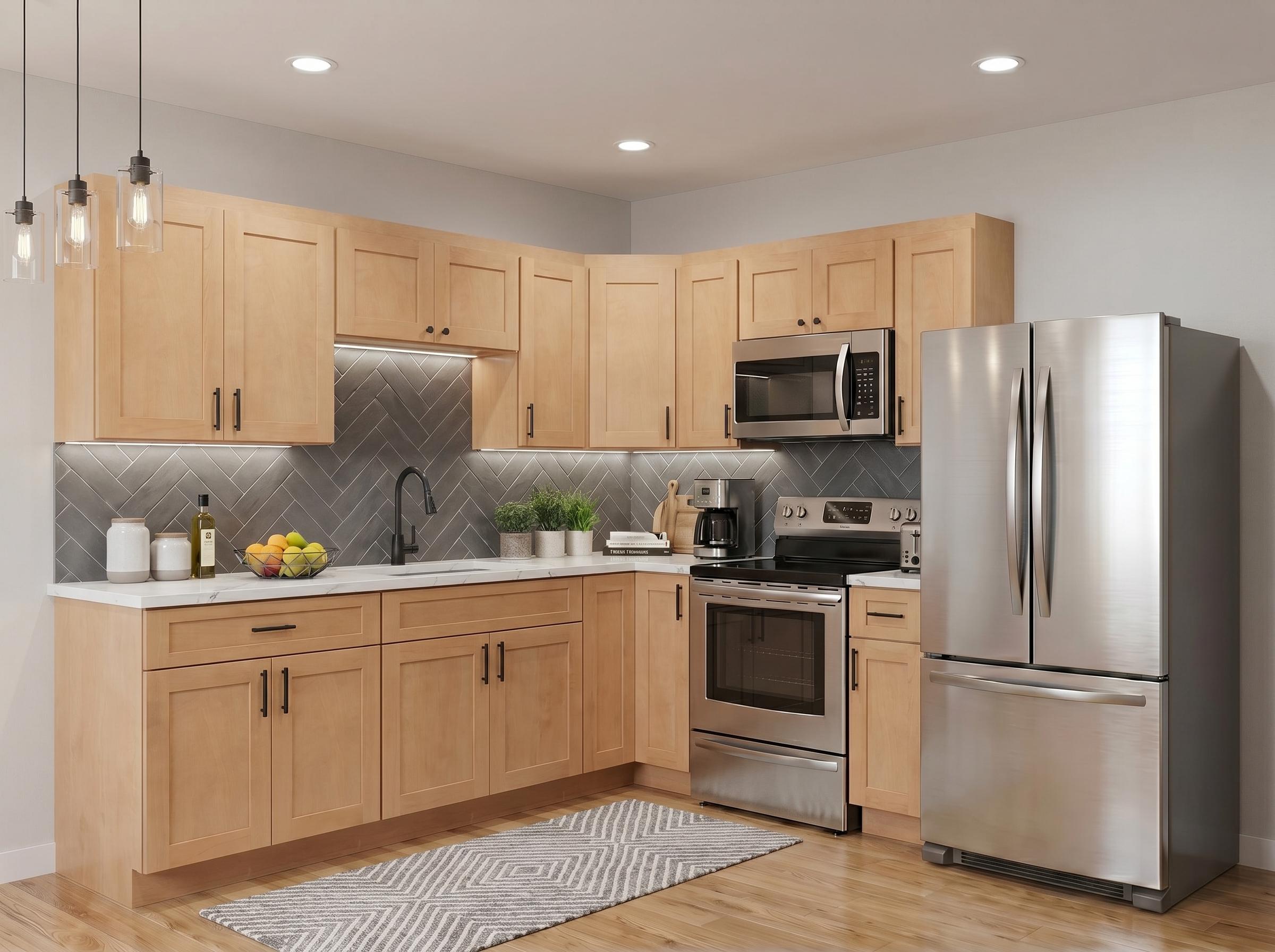
If you're shopping for kitchen cabinets and want to avoid MDF and particleboard entirely, you're asking the right question. Most cabinets sold in the US — including big-box and even some "premium" brands — use MDF or particleboard somewhere in their construction. The good news: true all-wood plywood cabinets exist, they're affordable, and you don't have to settle.
This guide explains how to spot real all-wood construction, the questions to ask any cabinet retailer, and what specific brands to consider when you want zero MDF and zero particleboard in your kitchen.
Why Avoid MDF and Particleboard in Kitchen Cabinets?
Both materials are engineered wood — meaning small wood pieces or fibers glued together with synthetic resin and pressed into panels. They're cheaper than plywood, smoother to paint, and lighter to ship. But they have three real problems in a kitchen:
- Moisture damage. MDF and particleboard swell, sag, and disintegrate when exposed to water. A leaking dishwasher or sink will destroy them — sometimes within days. Plywood survives the same exposure.
- Weak screw holding power. Cabinet hardware (hinges, drawer slides, wall-mount screws) is constantly under stress. Screws strip out of MDF and particleboard much faster than plywood.
- Off-gassing. Most MDF and particleboard use urea-formaldehyde resin, which releases volatile organic compounds (VOCs) for months after installation. Low-VOC versions exist but cost more and aren't always disclosed.
The honest truth: MDF isn't always bad. It's actually excellent for painted cabinet doors because it's smoother than plywood. Many high-end brands use plywood boxes with MDF doors. The problem is when manufacturers use particleboard for the cabinet box itself — that's where you want to draw the line.
What "All-Wood" Actually Means (And Where It Gets Misleading)
"All-wood cabinets" should mean every structural part of the cabinet is solid wood or plywood — no MDF, no particleboard, anywhere. But the term gets used loosely.
Here's what to watch for:
| Marketing Term | What It Often Actually Means |
|---|---|
| "All-wood construction" | Usually means plywood box, but doors and drawer fronts may be MDF. Ask specifically. |
| "Solid wood" | Usually refers to door frames and drawer fronts, not the box. Boxes are rarely solid wood. |
| "All-plywood box" | The box (sides, back, bottom, top) is plywood. Doors and drawers may vary. |
| "Engineered wood" | Usually a polite way of saying particleboard or MDF. |
| "Wood composite" | Same — usually particleboard or MDF. |
| "Furniture-grade" | Means nothing specific. Marketing fluff. |
The 5 Parts of a Cabinet to Verify
A kitchen cabinet has five main components. Each can be made of different materials, so ask about all five before you buy:
- Cabinet box (sides, back, top, bottom): This is the structural shell. This is the most important part to verify. Plywood is what you want.
- Cabinet back panel: Some manufacturers use plywood for the sides but cheap thin hardboard for the back. Ask specifically.
- Doors: Solid wood frames with MDF center panels are common and acceptable for painted doors. Solid wood throughout is best for stained finishes.
- Drawer box: Solid wood with dovetail joinery is the gold standard. Plastic clips and stapled boxes signal lower quality.
- Drawer bottom: A surprising weak point. Some brands use 1/8-inch hardboard or thin particleboard. Look for plywood drawer bottoms.
Questions to Ask Before You Buy
Use these exact questions when talking to any cabinet retailer or sales rep. If they can't or won't answer, walk away.
- "Is the cabinet box plywood or particleboard?"
- "What thickness is the plywood — 1/2 inch or 3/4 inch?"
- "What is the back panel made of?"
- "Are the drawer boxes solid wood with dovetail joinery, or stapled MDF?"
- "What are the drawer bottoms made of?"
- "Do the doors use MDF center panels, and are they CARB Phase 2 certified for low VOCs?"
Watch out: Some brands say "all-wood construction" but use particleboard or MDF for the back panel and drawer bottoms. Get specifics in writing before ordering.
Brands That Actually Sell All-Wood Cabinets
Most major retailers — IKEA, Home Depot's lower lines, and most big-box cabinets — use particleboard or MDF for cabinet boxes. Here are brands that genuinely offer all-plywood construction:
| Brand | Box | Doors | Drawers | Notes |
|---|---|---|---|---|
| Quik Cabinets | All plywood | Solid birch wood | Dovetail solid wood | Factory-direct, no particleboard anywhere. See construction. |
| Lily Ann | Plywood | Solid wood | Dovetail | Online DTC. Higher pricing than Quik. |
| Cabinets To Go | Mixed by line | Mixed | Mixed | Lower tiers use particleboard. Verify by line. |
| IKEA SEKTION | Particleboard | Various | Plastic clips | Avoid if you want all-wood. |
| Home Depot Hampton Bay | Plywood (Designer Series only) | Various | Stapled | Base lines use particleboard. Designer Series upgrade required. |
| Custom local cabinet shops | Usually plywood | Solid wood | Dovetail | Best quality but 2-3× the price of online DTC. |
How Much More Do All-Wood Cabinets Cost?
This is the question that stops most buyers. The honest answer: not as much as you'd think, if you buy direct.
| Source | 10×10 Kitchen (Estimated) | Construction |
|---|---|---|
| IKEA SEKTION | $2,000–$3,000 | Particleboard box |
| Home Depot base lines | $3,000–$5,000 | Particleboard box |
| Quik Cabinets (all-plywood) | $2,300–$2,800 | All-plywood, dovetail drawers |
| Lily Ann (all-plywood) | $3,500–$5,000 | Plywood, dovetail |
| Custom showroom (all-plywood) | $8,000–$15,000 | Plywood, dovetail, custom |
Buying factory-direct online removes the showroom markup that traditionally made all-wood cabinets expensive. Our 10×10 kitchen pricing is competitive with IKEA SEKTION while delivering all-plywood construction throughout.
Order Door Samples
See and feel our all-plywood construction before you order. $30 each, shipping included, credited to your order.
Order Door Samples Browse CabinetsWhat About the Doors? MDF Center Panels Are Common
Here's a nuance worth knowing: even high-quality cabinet brands often use MDF for the center panel of painted Shaker doors. This is because MDF takes paint better than plywood — it has no grain to show through, no joints to crack, no expansion/contraction with humidity.
For painted doors (white, gray, blue, green), an MDF center panel inside a solid wood frame is actually preferable. It looks better, holds paint longer, and the wood frame provides the structural strength.
For stained or natural wood doors, you want solid wood throughout — MDF can't be stained because it has no grain.
So a cabinet that says "solid wood doors" might still have an MDF center panel if it's a painted finish, and that's fine. Just understand what you're getting.
Are All-Wood Cabinets Worth It?
For most homeowners staying in their home 5+ years, yes. Here's why:
- Lifespan: All-plywood cabinets last 30–50 years. Particleboard cabinets typically need replacement in 10–15 years.
- Resale value: Real estate appraisers and buyers can tell the difference. All-wood cabinets are a documented selling point.
- Moisture resilience: A burst pipe or leaking dishwasher won't destroy plywood cabinets the way it ruins particleboard.
- Hardware longevity: Hinges and drawer slides stay tight in plywood for decades. They strip out of particleboard within years.
- Refinishing potential: Plywood cabinets can be sanded and refinished. Particleboard cannot.
For renters, flippers, or short-term housing, particleboard may be acceptable for cost reasons. For your own kitchen — the room you'll use 365 days a year for the next decade or more — pay for plywood.
Quik Cabinets: All-Wood From Box to Door
We built Quik Cabinets specifically for buyers who don't want particleboard or MDF in their cabinet box. Every SKU we sell uses:
- 3/4-inch furniture-grade plywood for cabinet sides, back, top, and bottom
- Solid birch wood for door frames and styles
- Solid wood drawer boxes with dovetail joinery — not staples, not plastic clips
- 1/2-inch plywood drawer bottoms — not hardboard, not particleboard
- Soft-close hinges and drawer slides on every cabinet, included standard
- 5-year limited warranty on everything
Doors with painted finishes (Aspen White, Tallis White, Slim Fog, etc.) have MDF center panels inside solid wood frames — the industry standard for painted Shaker doors. If you want zero MDF anywhere, our stained finishes (Antique, Toffee, Espresso, Barnwood) use solid wood throughout.
Frequently Asked Questions
Are all kitchen cabinets made with MDF or particleboard?
No, but most cabinets sold at big-box stores and many online retailers use particleboard for the cabinet box. True all-plywood cabinets exist but require asking the right questions. Online DTC brands like Quik Cabinets sell all-plywood construction at price points competitive with big-box particleboard.
Is plywood always better than MDF for cabinets?
For the cabinet box itself, yes. Plywood holds screws better, resists moisture better, and lasts longer. For painted door center panels, MDF is actually preferable because it takes paint smoother and resists cracking from humidity changes.
How can I tell if cabinets are real plywood or particleboard?
Look at the edge of the cabinet box. Plywood shows distinct horizontal layers (plies). Particleboard looks like compressed wood chips. MDF looks like smooth dense fiber with no visible grain. Most retailers will let you see the edge of a sample if you ask.
Do all-wood cabinets cost a lot more than particleboard ones?
Not anymore, if you buy factory-direct online. A 10×10 kitchen in our all-plywood Ardelle Aspen White runs $2,300–$2,800 — comparable to IKEA SEKTION (particleboard) and significantly less than custom showroom plywood ($8,000+). The traditional 2-3× price gap is mostly showroom markup.
What about IKEA cabinets — are they MDF or particleboard?
IKEA SEKTION cabinet boxes are particleboard with a melamine coating. The drawer boxes use plastic cam-lock clips. While durable for the price point, they're not all-wood. If you want plywood construction at a similar price, factory-direct online brands are the alternative.
Are MDF cabinets safe (off-gassing concerns)?
Modern MDF that's CARB Phase 2 certified has very low formaldehyde emissions and is considered safe. Older or non-certified MDF can off-gas VOCs for months. If you have respiratory sensitivities or want to minimize indoor air pollutants, all-plywood cabinets eliminate that concern entirely.
Will all-wood cabinets last longer than particleboard?
Yes — typically 2-3× longer. All-plywood cabinets routinely last 30–50 years with normal use. Particleboard cabinets typically need replacement in 10–15 years, often sooner if exposed to moisture (leaking dishwasher, sink overflow, etc.).
How to Move Forward
If you've decided you want kitchen cabinets without MDF or particleboard in the box, your shopping process becomes much simpler:
- Skip particleboard-based brands like IKEA SEKTION, Home Depot base lines, and Costco entry tiers
- Compare all-plywood DTC brands on construction details, finish options, and pricing
- Order door samples first from your top 2–3 candidates — feeling the actual material is the best test
- Ask all five construction questions from earlier in this article before placing an order
- Get pricing in writing with the construction specs included, so there's no confusion later
The DTC online cabinet market has changed what's possible at every price point. You no longer have to choose between "cheap with particleboard" and "expensive with plywood." All-wood, all-plywood cabinets at competitive prices are real, and they're the right choice for almost any homeowner staying in their home long-term.
Start With a Door Sample
Hold our all-plywood construction in your hand. Door samples ship in any of our 10 finishes for $30, credited to your order — no obligation, no pushy sales call.
Order Door Samples Free 3D Design