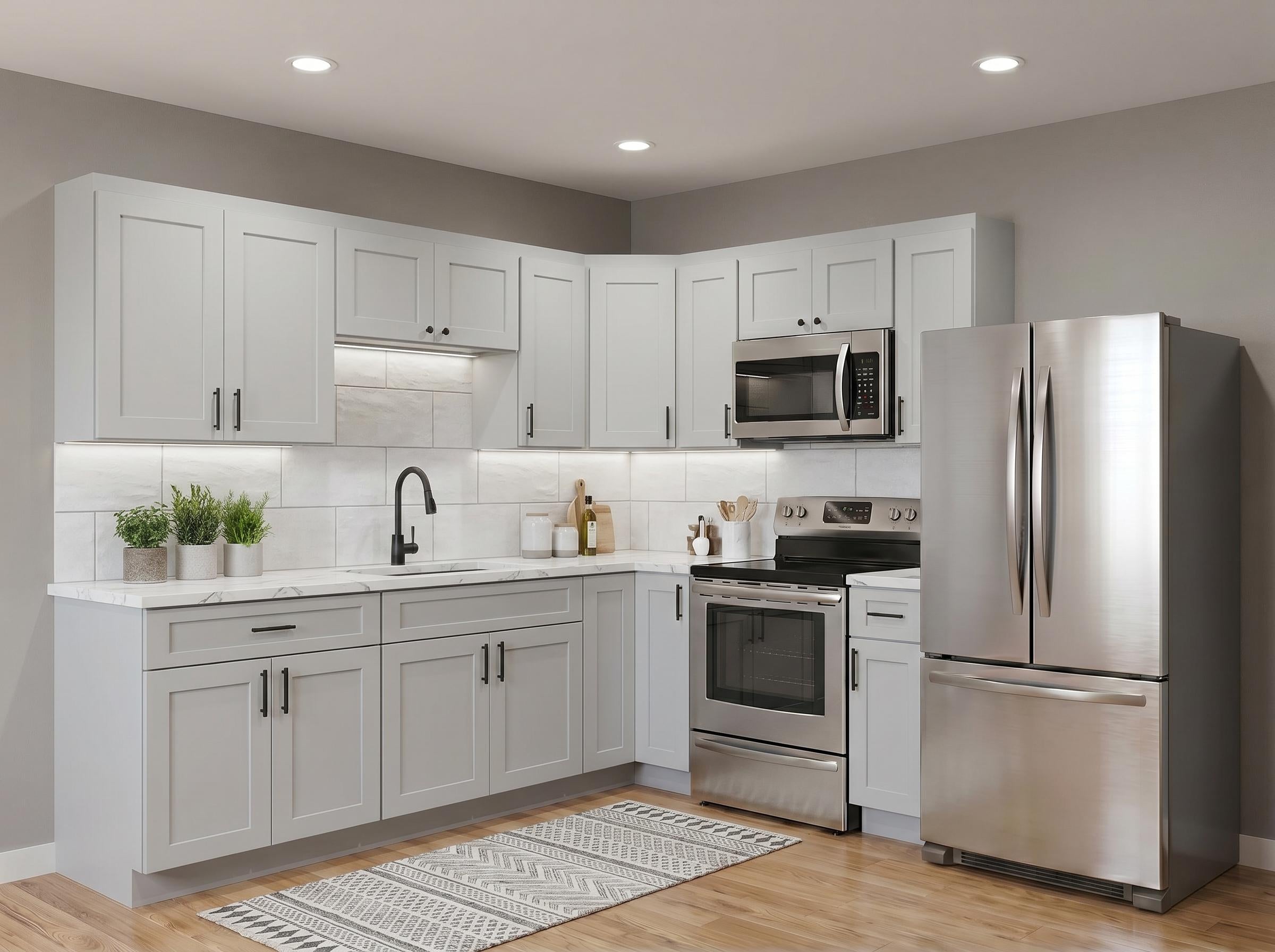
If you're considering RTA (ready-to-assemble) kitchen cabinets to save money on your remodel, you're probably wondering: can I really install these myself, or should I hire a pro? The honest answer is, it depends on your skill level, kitchen layout, and how much you value your weekends. This guide walks you through the full RTA cabinet installation process step-by-step, plus the clear situations where hiring a pro is genuinely the smarter financial decision.
What you'll learn
What Are RTA Cabinets?
RTA stands for ready-to-assemble. These cabinets ship flat-packed in boxes — sides, backs, doors, and drawers all separated — and you assemble them yourself before installation.
The trade-off is straightforward: RTA cabinets cost 30–50% less than the same cabinets pre-assembled. In exchange, you spend a few extra hours putting them together. For most DIYers, that math works in their favor.
RTA does not mean low quality. The exact same cabinet box can be sold pre-assembled at a showroom for $400 or RTA online for $200. The cabinet is identical — you're paying for showroom overhead and assembly labor, not better wood or hardware. Read about our construction quality.
Can You Really Install RTA Cabinets Yourself?
Yes — but only if you're honest about your skill level and patience.
The DIY-friendly truth
Most RTA cabinet brands, including ours, design cabinets to be assembled with basic tools. If you can use a screwdriver, follow written instructions, and lift 30–50 pounds without injuring yourself, you can install RTA cabinets in a typical kitchen.
Plan for these realistic time estimates:
- Cabinet assembly: 15–30 minutes per cabinet
- Wall cabinet installation: 30–60 minutes per cabinet (with a helper)
- Base cabinet installation: 30–45 minutes per cabinet
- Total for an average 10×10 kitchen: 12–20 hours of work, spread across 1–2 weekends
When you should definitely hire a pro
Skip the DIY route if any of these apply to your project:
- Your floors or walls are out of level by more than 1 inch
- You have a very old home with plaster walls (not drywall)
- Your kitchen has unusual angles, soffits, or load-bearing complications
- You're moving plumbing or electrical (you'll need permits and licensed trades)
- You don't have a helper for lifting and holding cabinets in place
- You're working under time pressure — a kitchen torn apart for 3 weekends is not the same as 3 weeks for a pro
Tools and Materials You'll Need
Essential tools — don't start without these
| Tool | Why You Need It |
|---|---|
| 4-foot level | Getting cabinets level is the #1 thing pros and DIYers get wrong. Don't skip the long level. |
| Stud finder | Wall cabinets must be screwed into wall studs — not just drywall. |
| Cordless drill/driver | For pre-drilling and driving screws. Do not use an impact driver — it strips screws. |
| Tape measure | Obvious, but get a 25-foot one. Stop measuring with the tiny one in your junk drawer. |
| Pencil and notepad | Marking layout lines and tracking measurements as you go. |
| Wood shims (3 bundles) | Floors are never level. Shims fix that. |
| 2½-inch wood screws | Standard for attaching cabinets to wall studs. Buy a 1-pound box. |
| 1×2 ledger board | A temporary support strip you screw to the wall to hold up cabinets while you install them. Cheap and a back-saver. |
| Clamps (8-inch opening) | Holding adjacent cabinets together while you screw them. |
| Screwdriver (Phillips and flathead) | For final adjustments and hardware that doesn't take a drill bit. |
Optional but helpful
- Rubber mallet (gently tapping panels into place during assembly)
- Cabinet jack or improvised plywood support (holding wall cabinets in place if you're working alone)
- Drop cloth (protects floors and finished cabinets during work)
- Painter's tape (marking measurements on walls without leaving permanent lines)
Don't use an impact driver to assemble RTA cabinets. The high torque strips the cam-lock screws and softer wood. Use a regular drill/driver with the clutch set to medium, or just a screwdriver. Slow and steady wins.
The 6-Step RTA Installation Process
Here's the same sequence professional cabinet installers use, simplified for DIYers. Read all 6 steps before you start — many mistakes happen because people skip ahead.
1Prepare Your Space and Plan the Layout
Remove old cabinets, patch any holes, and make sure walls and floors are clean. Then identify the highest point on your floor — this is where your base cabinets will start. Measure 34½ inches up from this high spot and draw a level horizontal line. This is your base cabinet top reference line.
For wall cabinets, measure 54 inches from the same high floor spot (this gives you an 18-inch backsplash). Draw another level line.
Use your kitchen design plan (or our free 3D design service) to mark exactly where each cabinet will go on the wall.
2Find and Mark Your Wall Studs
Wall cabinets must be anchored to studs — not just drywall. Use your stud finder along the cabinet line and mark each stud with a pencil. Studs are typically 16 inches apart in modern construction. Verify by tapping with a hammer; a stud sounds solid, drywall sounds hollow.
3Assemble the RTA Cabinets
Open one box at a time. Lay all parts and hardware on a clean, flat surface. Read the assembly instructions for that specific cabinet — instructions vary slightly by cabinet type (base vs. wall vs. corner).
Most RTA cabinets follow this general pattern:
- Lay the side panels flat with holes facing up
- Add a small amount of wood glue in dowel holes (not in cam-lock holes)
- Insert dowels and connect side panels to the bottom panel
- Attach the back panel
- Install drawer glides and shelf supports
- Attach doors and adjust hinges last (after the cabinet is on the wall)
4Install Wall Cabinets First
Counterintuitive but critical: install wall cabinets before base cabinets. This way you're not leaning over base cabinets and risking damage to them.
Screw your 1×2 ledger board to the wall along your top reference line. This holds the bottom of the wall cabinets while you screw them in.
Start with the corner cabinet. With a helper holding it level, drive 2½-inch screws through the cabinet's mounting strip into the wall studs. Use shims behind the cabinet to keep it perfectly plumb.
Work outward from the corner. Clamp adjacent cabinets together at the face frame before screwing them to each other and to the wall.
5Install Base Cabinets
Base cabinets get screwed to the wall and to each other. Start with the corner base cabinet, level it using shims under the toe kick, then add adjacent cabinets working outward.
Check level constantly — both side-to-side and front-to-back. Countertops will fail to sit flat if base cabinets aren't level, and that's a much bigger problem to fix later.
6Install Doors, Drawers, and Hardware
Once cabinets are mounted, install doors using the included hinges. Most modern hinges (including ours) have adjustment screws on three axes — vertical, horizontal, and depth. Use them. Doors will look uneven at first; that's normal.
Slide drawers onto the glides, attach drawer fronts, then install pulls and knobs last.
Common RTA Installation Mistakes (and How to Avoid Them)
| Mistake | How to Avoid It |
|---|---|
| Not finding the floor's high point | Use a long level + 2×4 to find the highest spot on the floor before drawing layout lines |
| Skipping the ledger board | That little 1×2 saves your back and keeps wall cabinets aligned. Always use one. |
| Using an impact driver on cam-lock screws | Strips the screws every time. Use a hand screwdriver or low-torque drill/driver. |
| Forgetting to plan for plumbing/electrical | Mark plumbing and outlet locations on the wall before installing — drilling into a pipe ruins your day. |
| Hanging cabinets from drywall only | Always anchor into studs. Drywall alone holds about 50 pounds; a loaded wall cabinet weighs 80–150 pounds. |
| Not adjusting doors after install | Adjust each hinge so doors close evenly with consistent gaps. Takes 30 minutes and looks pro. |
| Trying to do it solo | Wall cabinets weigh too much to hold one-handed while screwing them in. Get a helper. |
When to Hire a Professional Installer
Don't let DIY pride cost you more in the long run. Here are honest signs you should call a pro:
- Your home is older than 1970. Plaster walls, uneven floors, and odd framing make DIY a frustrating project.
- You're dealing with structural changes. Removing a wall, relocating plumbing, or upgrading electrical = professional territory.
- You've never used a drill before. Learning on a $5,000 cabinet order is the wrong place to start.
- You don't have 2 free weekends. Pros finish a typical kitchen in 2–4 days. DIYers take 2–4 weekends.
- Your kitchen has corner blind cabinets, oversized islands, or custom inserts. These are tricky even for pros.
- You'd rather not deal with it. That's a valid reason. Hire it out and enjoy your weekend.
How Much Does Professional Cabinet Installation Cost?
For a typical 10×10 kitchen in the US in 2026, expect:
| Service | Typical Cost Range |
|---|---|
| Pre-assembled cabinet installation only | $1,500–$3,500 |
| RTA cabinet assembly + installation | $2,000–$4,500 |
| Per-cabinet rate (some installers price this way) | $100–$200 per cabinet |
| Full kitchen remodel labor (cabinets only) | $2,500–$5,000 |
Where you live matters significantly. Major metros (NYC, SF, LA, Boston) run 30–50% higher than the national average. Rural and small-city installers charge less.
A typical 10×10 kitchen in our Ardelle Aspen White finish runs $2,400–$3,100 in cabinets. Adding $2,500 for professional installation makes the project $5,000–$5,600 total. That's still significantly less than $10,000+ at a traditional showroom. Get a free 3D design and quote to see real numbers for your kitchen.
Order Free Door Samples Before You Commit
The smartest way to start any cabinet project: order free samples first. See the actual finish in your kitchen light, feel the construction quality, and confirm your choice before placing the full order.
Order Free Samples → Free 3D DesignRecommended Reading
- How to Measure Your Kitchen for Cabinets — get measurements right before you order
- RTA vs Pre-Assembled Cabinets: Which Should You Choose?
- Quik Cabinets Assembly Guides — video walkthroughs for every cabinet type
- Quik vs IKEA Cabinets — full construction comparison
Frequently Asked Questions
For an average 10×10 kitchen, plan on 12–20 hours of total work for an experienced DIYer, spread across 1–2 weekends. First-time DIYers should add another 50%. Professional installers complete the same kitchen in 2–4 days.
You can assemble RTA cabinets alone, but you absolutely need a helper for installation — especially wall cabinets. They're too heavy to hold one-handed while screwing in. You can rent or build a cabinet jack to substitute for a helper, but it's slower and less safe.
Skipping the level check on the floor. If your floor is out of level and you don't compensate with shims, your countertops won't sit flat, drawers won't slide right, and the entire kitchen will look subtly "off" forever. Measure from the highest point on the floor, draw level layout lines, and shim aggressively where needed.
Yes — every Quik Cabinets order ships with written assembly instructions. We also provide video walkthroughs for every cabinet type on our website. The instructions are written for first-time DIYers, not professionals.
Generally, install cabinets first. This protects new flooring from scratches, lets you anchor cabinets to a stable surface, and avoids paying for flooring under cabinets where no one will see it. Exception: floating laminate or vinyl planks should be installed wall-to-wall before cabinets to allow proper expansion.
Professional RTA assembly + installation for a typical 10×10 kitchen runs $2,000–$4,500 in 2026, varying by region. Major metros are 30–50% higher than the national average. Some installers charge per cabinet ($100–$200 each); others charge a flat project fee.
Stop and contact us before you proceed. We can usually ship a replacement part (a single panel or door) faster and cheaper than replacing the whole cabinet. Email or call us with photos of the damage and we'll guide you through the next step.
Ready to Start Your RTA Cabinet Project?
DIY RTA cabinet installation isn't hard, but it does require patience, the right tools, and an honest assessment of your skills. Most homeowners who follow the 6-step process above end up with a kitchen they're genuinely proud of — for thousands less than a showroom would charge.
If you're not ready to commit, start small: order free door samples. Hold the actual finish in your kitchen light, feel the construction quality, and confirm your choice before the full order. It's the lowest-risk way to start a kitchen remodel.
Start With Free Samples
Order door samples in any of our 10 finishes — free shipping, no obligation. The smartest first step before any cabinet project.