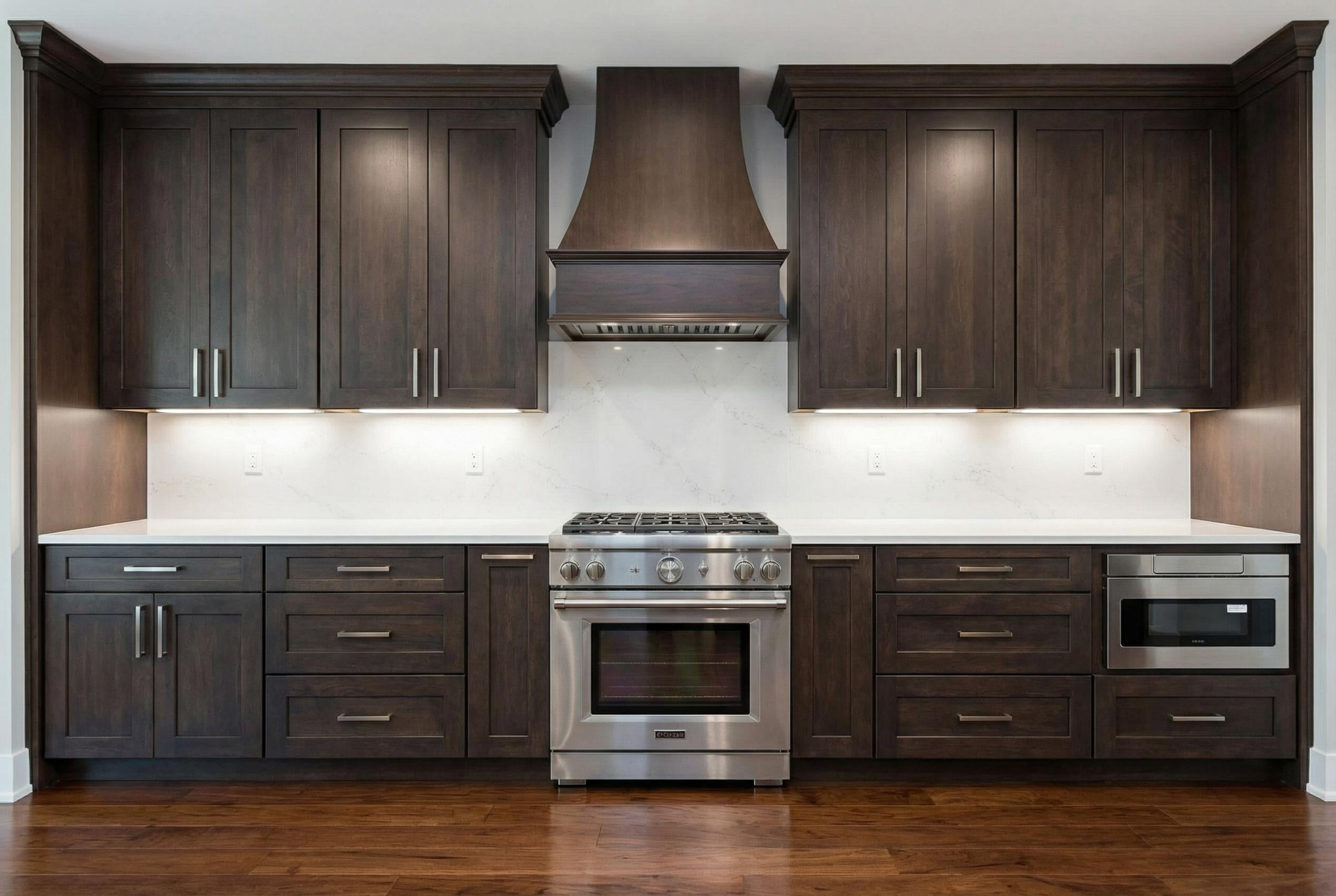
White kitchens had a long run. They're still beautiful — but if you've been pinning kitchens lately, you've probably noticed a shift. Deep, smoky, confident charcoal is showing up everywhere, and it's not just a trend. Charcoal kitchen cabinets hit a sweet spot that white can't: warm enough to feel inviting, dark enough to feel intentional, and forgiving in ways pure black never is.
If you're weighing a charcoal kitchen, here's what actually makes it work — and where most homeowners go wrong.
Why charcoal — and why now?
Charcoal isn't black, and it isn't gray. It's the in-between zone where a deep, neutral-leaning hue still reads as soft. Under warm lighting it leans almost coffee-brown. Under cool daylight it pulls slate. That chameleon quality is exactly why it photographs so well and why it ages better than the cooler grays that dominated kitchens five years ago.
A few things are pushing charcoal forward right now:
- Brass and warm-metal hardware is back, and charcoal is its perfect backdrop.
- Open-concept homes need an anchor — a dark island or full charcoal run gives a great room its visual gravity.
- After a decade of all-white kitchens, buyers and homeowners are craving warmth and contrast.
Charcoal vs. black vs. dark gray: what's actually different?
These three get used interchangeably online, but they behave very differently in a real kitchen.
Pure black cabinets are dramatic but unforgiving. Every smudge, every speck of dust, every scratch shows. Black also flattens — it absorbs so much light that detail in the door profile disappears.
Dark gray cabinets (think battleship, slate) can read cold, especially in north-facing kitchens. They were the safer choice five years ago but tend to feel dated when paired with cool whites and chrome.
Charcoal cabinets sit between the two. There's enough warmth in the undertone to feel inviting, and enough depth in the value to still read as a bold, modern choice. The shaker door profile, in particular, keeps that depth from feeling heavy.
Quick tip: If you're shopping online, request a door sample before committing. Charcoal looks dramatically different in showroom lighting versus your actual kitchen at 7 a.m. and 8 p.m.
Why charcoal shaker is the sweet spot
The shaker door profile is the most-installed door style in America, and there's a reason it became the default. Clean lines, recessed center panel, no ornate detailing — it's a profile that flatters almost any color and almost any home style, from craftsman to modern farmhouse to transitional.
Pair that simple profile with charcoal and you get something rare in cabinetry: a look that feels current today and will still feel current in ten years. Shaker doesn't go in and out of style. Charcoal doesn't telegraph a specific year the way greige or espresso did.
Charcoal shaker cabinets also forgive the things homeowners worry about with dark finishes. The recessed panel adds dimension, so even in a small kitchen the cabinets don't read as a flat wall of darkness. The flat surfaces clean easily. And the matte finishes that have become standard in shaker construction hide fingerprints far better than glossy doors.
Designing around charcoal: what to pair them with
Countertops
Charcoal wants contrast, not competition. The strongest pairings:
- White quartz with subtle veining — the cleanest, most timeless option.
- Calacatta-style marble looks — the warm gold veining echoes brass hardware beautifully.
- Soft cream or bone-colored quartz — warmer than pure white, easier on the eye in larger kitchens.
- Butcher block on an island — the wood warmth against charcoal is a designer-favorite combination.
Avoid: dark granite (too busy), bright white quartz with cool blue undertones (clashes with charcoal's warmth).
Hardware
This is where charcoal kitchens earn their reputation. The dark backdrop turns hardware into jewelry.
- Unlacquered brass — develops a living patina and feels timeless.
- Champagne bronze — softer than brass, slightly more contemporary.
- Matte black — quiet, modern, disappears into the cabinet for a minimalist look.
- Aged or burnished brass — vintage feel, beautiful with stone countertops.
Skip polished chrome and brushed nickel — both fight charcoal's warmth and can make the kitchen feel mismatched.
Backsplash
The simplest move is a white or off-white subway tile in a herringbone or stacked pattern. For more drama, consider a full-height slab backsplash matching the countertop — it lets the charcoal cabinets do the talking. Zellige tile in warm white or terracotta also works beautifully if you want texture.
Flooring
Light wood floors (white oak, natural hickory) are the most popular pairing because they balance the cabinet weight. Wide planks in a matte finish look intentional and modern. If you have existing dark floors, you can still make charcoal cabinets work, but plan for a brighter wall color and more lighting to keep the room from feeling heavy.
Wall color
Warm whites and bone-tones (Benjamin Moore White Dove, Swiss Coffee, Alabaster) consistently outperform stark whites against charcoal. The slight warmth in the wall paint keeps the kitchen from feeling clinical.
Lighting: the make-or-break factor
Every successful charcoal kitchen has one thing in common: thoughtful lighting. Dark cabinets absorb light, and a kitchen that looked great in the showroom can feel cave-like at home if you skip this step.
Under-cabinet lighting is not optional. LED strips or pucks under every upper cabinet brighten the work zone and add the warm glow that makes charcoal cabinets feel rich rather than heavy.
Use warm color temperatures. Stick to 2700K–3000K bulbs throughout. Cool white (4000K+) makes charcoal look gray and lifeless.
Add a statement pendant or two. Over the island or sink, a pair of brass, blackened steel, or amber-glass pendants will pull the whole room together.
Who should choose charcoal — and where to use it
Charcoal kitchens reward homeowners who want their kitchen to feel like a designed space, not a builder's default. They're particularly strong in:
- Homes with good natural light. South- and east-facing kitchens handle full charcoal effortlessly.
- Open-concept floor plans. Dark cabinets give an open kitchen visual weight and definition.
- Transitional and modern homes. Charcoal bridges traditional and contemporary effortlessly.
If your kitchen is small, north-facing, or already feels dim, you have options:
- Two-tone: charcoal lowers, white or natural-wood uppers. Grounds the kitchen without weighing it down.
- Charcoal island only: a single charcoal island in a white kitchen is one of the most popular looks of the past two years.
- Charcoal pantry wall: use charcoal on a tall pantry or appliance wall as an accent.
Three mistakes that ruin charcoal kitchens
- Going charcoal on every surface. Charcoal walls, charcoal cabinets, dark floors, and dark counters create a tomb, not a kitchen. Lean on one or two charcoal moments, then let lighter materials breathe.
- Cool-white LED bulbs. The single fastest way to make charcoal look gray and dingy. Warm bulbs only.
- Mismatched undertones. Charcoal leans warm. Cool-toned whites, chrome, and stark blue-grays fight it. Pick a warm palette and stay consistent.
Charcoal shaker cabinets at Quik Cabinets
Quik Cabinets offers charcoal shaker cabinets across our online catalog — factory-direct pricing on the same all-wood construction you'd expect from a premium showroom, shipped straight to your door. Every door is a clean shaker profile, every box is all-plywood construction with a solid wood door frame, and our charcoal finish is hand-applied in a multi-step process designed to wear well over years of real-kitchen use.
Order a door sample to see the charcoal in your own light before you commit. Most homeowners are surprised by how much warmer it reads in their kitchen than in any photo.
See charcoal in your kitchen before you buy.
Order a door sample, browse the full charcoal shaker collection, or get a free design quote with a 3D layout.
Frequently asked questions
Do charcoal cabinets make a kitchen look smaller?
Only if you treat the whole kitchen as dark. Pair charcoal cabinets with white counters, light walls, and good lighting, and a small kitchen actually gains visual depth and feels more designed, not smaller.
Will charcoal kitchen cabinets go out of style?
Charcoal is closer to a neutral than a trend color. Combined with the timeless shaker door profile, it ages better than the cool grays of the 2010s or the espresso browns of the 2000s. It's a long-cycle choice.
Do charcoal cabinets show dust and fingerprints?
Less than pure black, and far less than high-gloss finishes. A matte or satin charcoal hides everyday smudges well. Wipe with a microfiber cloth and warm water — no special cleaners needed.
What countertop color works best with charcoal cabinets?
White or cream quartz with subtle veining is the safest, most timeless pairing. Warm-veined marble looks (Calacatta) add elegance, while butcher block adds warmth on an island. Avoid dark granite — it competes rather than contrasts.
Should I do charcoal on uppers, lowers, or both?
In bright, open kitchens, full charcoal looks intentional and dramatic. In smaller or darker kitchens, charcoal on lowers with white or natural-wood uppers (a two-tone look) keeps the space light while still grounding it.
What hardware looks best on charcoal shaker cabinets?
Warm metals win every time on charcoal: unlacquered brass, champagne bronze, or aged brass. Matte black works for a quieter, modern look. Avoid polished chrome and brushed nickel — both fight charcoal's warmth.